Where science meets practice - in the field
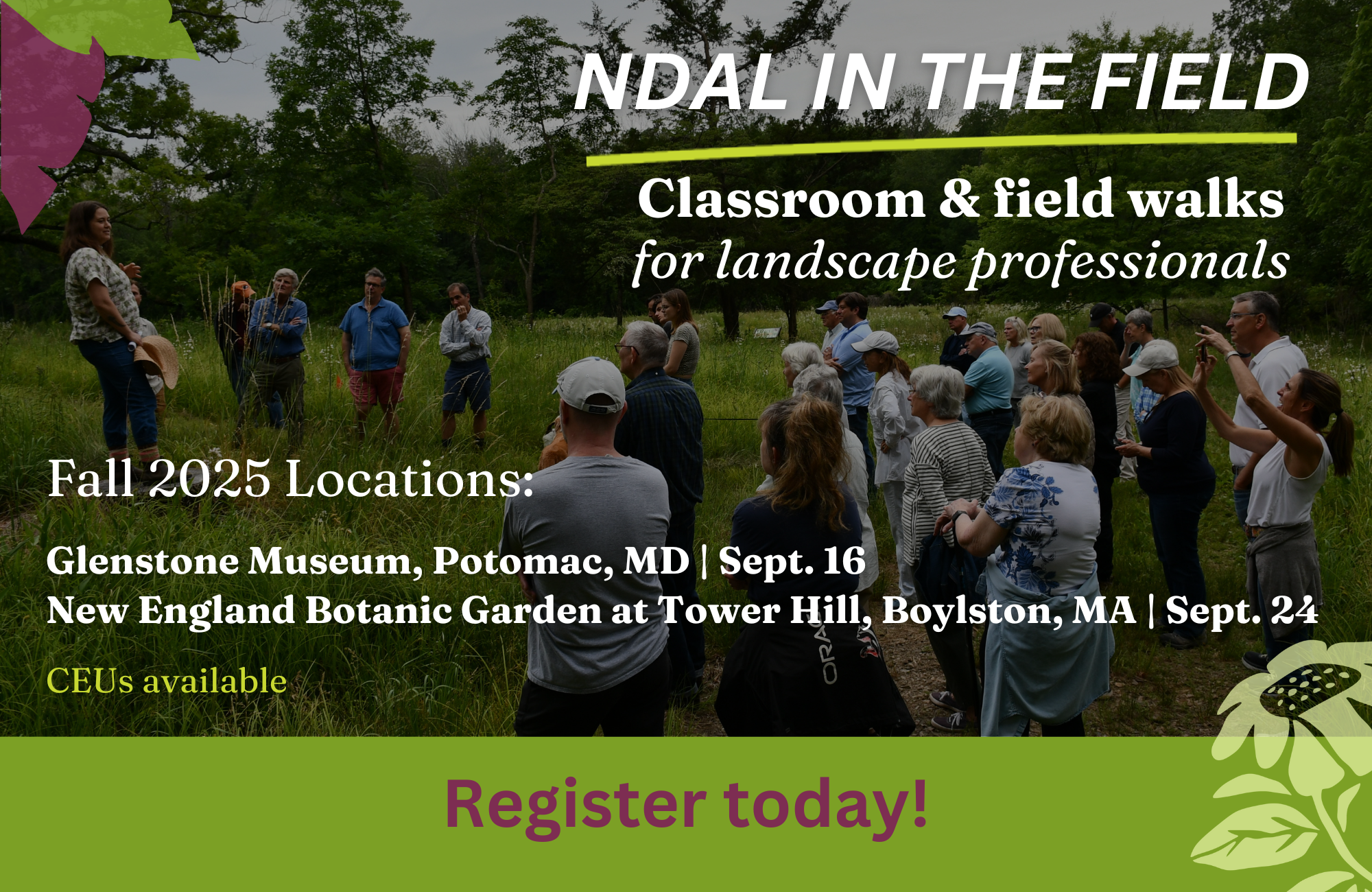
Two program locations: Maryland & Massachusetts
Each program will be tailored to its respective eco-region
Produced in partnership with our hosts:
Glenstone Museum, Potomac, MD

New England Botanic Garden at Tower Hill, Boylston, MA
The Glenstone field session is now sold out! Thank you for your interest.
Scroll down for program details.
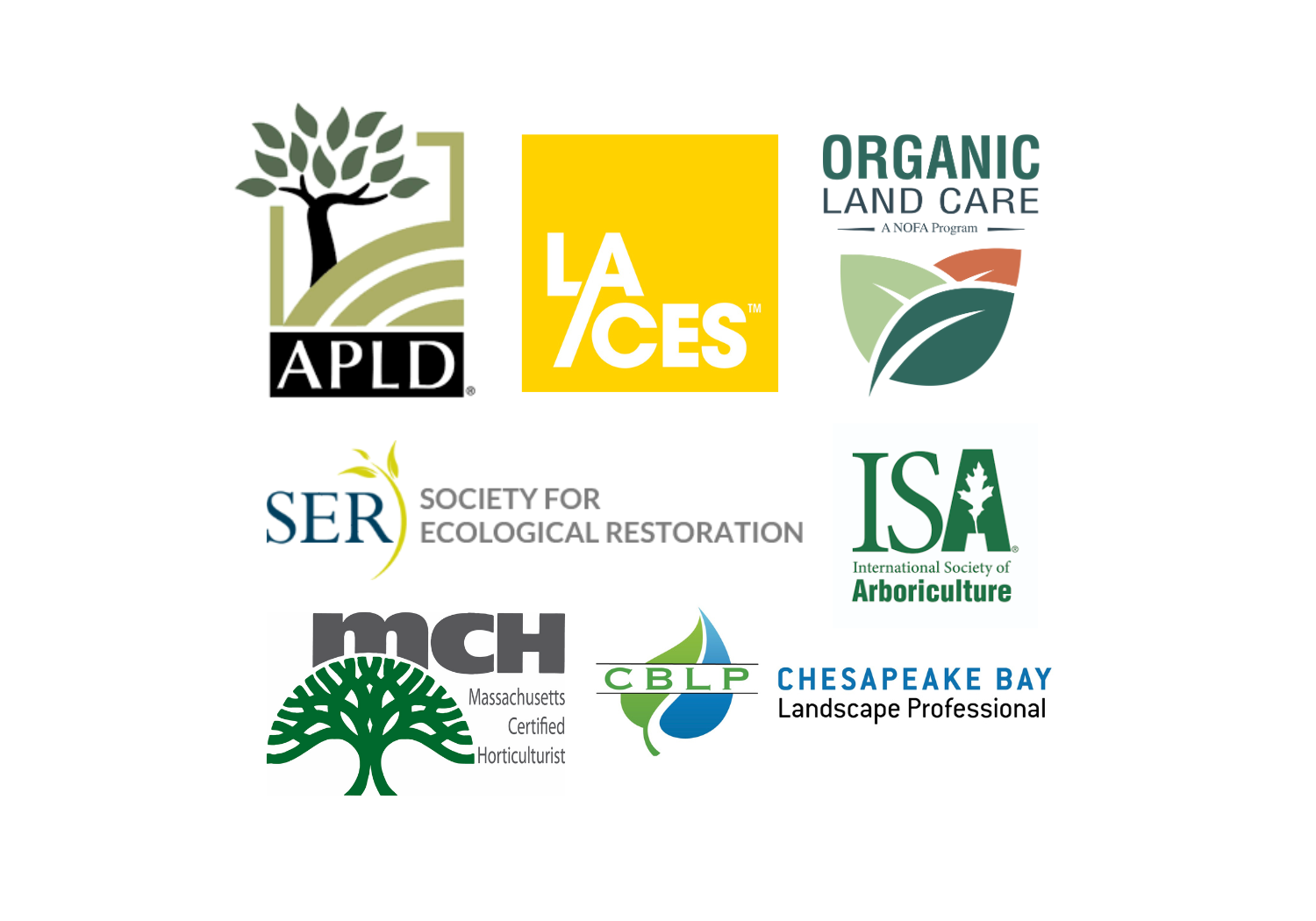
CEUs available:
APLD, CBLP, ISA, LA CES, MNLA/MCH, NOFA, SER
Student, Wild Ones, and NOFA AOLCP member discounts available!
Scroll down below the program descriptions for registration, NDAL Portal, group & gift orders, and discount details.
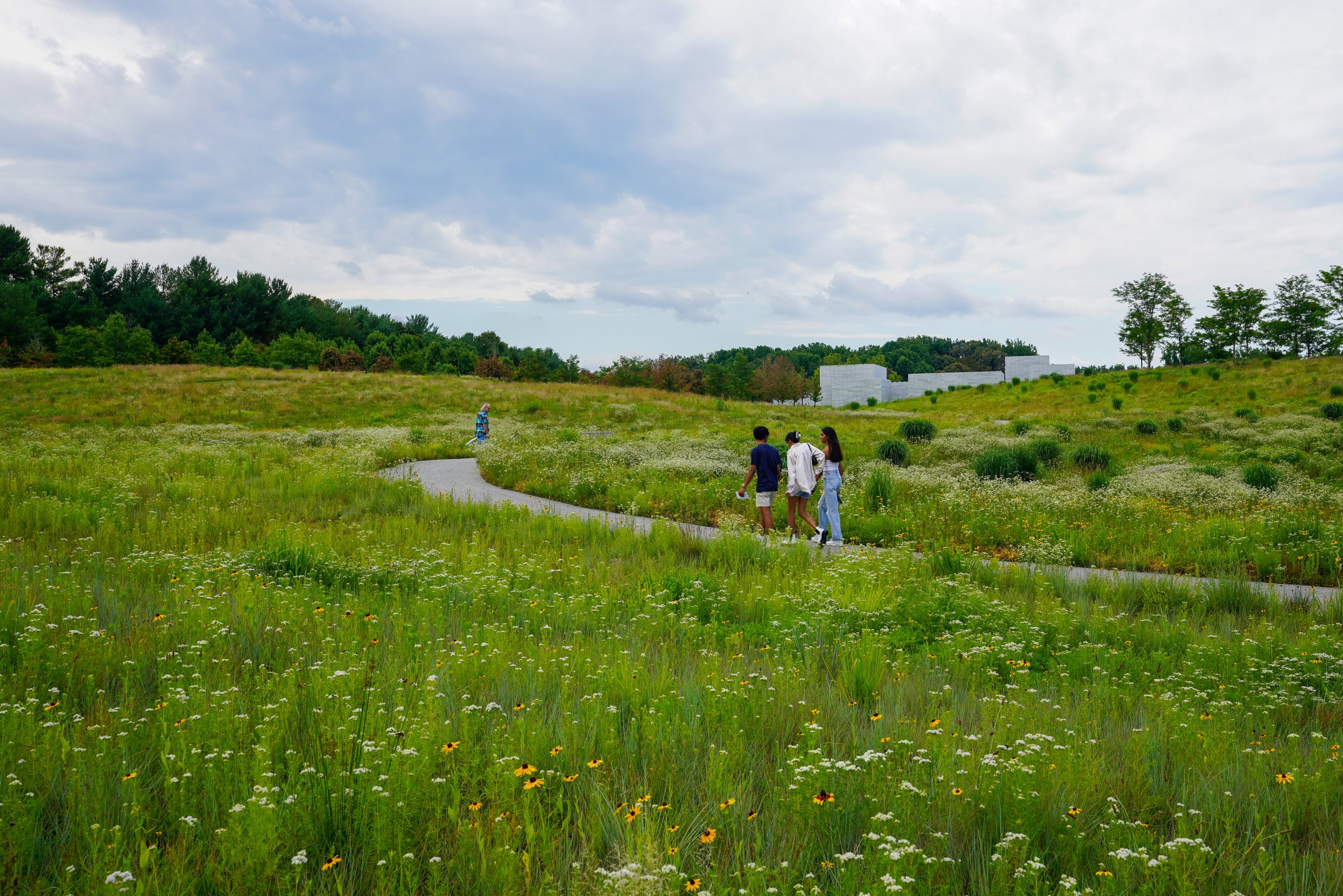
Glenstone Museum, Potomac, MD
Photo by Larry Weaner Landscape Associates
Ecology-based Design and Organic Practice at Glenstone Museum
An In-Person Program for Landscape Professionals
Sold out!
Produced by:
Glenstone Museum
New Directions in the American Landscape (NDAL)
When: Tuesday, September 16th, 2025 | 9:00 - 4:30 PM ET
Where: Glenstone Museum in Potomac, MD
Instructed by:
Trevor Garbow, Matt Partain, and Larry Weaner, FAPLD
Program Description:
The landscape at Glenstone, a newly-constructed, contemporary art museum in Potomac, Maryland, received the ASLA Honor Award in 2019. The property contains 90 acres of planted meadows, shrub thickets, and reforestation that stretch from the property borders to the museum buildings. This organically planted and maintained landscape illustrates how landscape architects (PWP Landscape Architecture), native plant consultants (Larry Weaner Landscape Associates), and an in-house management team can collaborate in the service of ecology, art, and a stimulating visitor experience. Our day will combine classroom instruction with a heavy dose of field observation to illustrate how this landscape went from landscape plans to vibrant reality.
Instructor Bios:
-
Trevor Garbow is Deputy Landscape Superintendent of Glenstone Museum. Trevor's transition from golf course management to native meadows exemplifies his commitment to sustainable practices and his aspiration to make a meaningful difference in the environment. With a strong focus on organic landscape management and the integration of native plants, Trevor and his team are not only creating visually stunning spaces but also setting a remarkable precedent for others to embrace environmentally responsible approaches to landscaping. Their dedication contributes to the overall vitality and harmony of the environment, leaving a positive impact on the local ecosystem and the broader community.
-
Matt Partain oversees an organic planting and management program over nearly 300 acres of native landscape and restoration areas at the Glenstone Museum in Potomac, MD. He is a graduate of the University of Georgia in Landscape Management. Matt has presented at 2022 ASLA Conference on Landscape Architecture, 2020 NDAL Symposium, 2020 Mt Cuba Educational Series, and to multiple garden clubs. He has also taught classes for the Federation of Garden Clubs Landscape Design School.
-
Larry Weaner, FAPLD, founded Larry Weaner Landscape Associates in 1982 and New Directions in the American Landscape in 1990. His nationally recognized work combines horticulture, landscape design, and ecological restoration, and spans more than twenty U.S. states and the U.K. He has been profiled in national publications. His book, Garden Revolution: How Our Landscapes Can Be a Source of Environmental Change (Timber Press 2016), coauthored by Tom Christopher, received an American Horticultural Society (AHS) Book Award in 2017. In 2021 he received the AHS “Landscape Design Award” and the Association of Professional Landscape Designers (APLD) “Award of Distinction.”
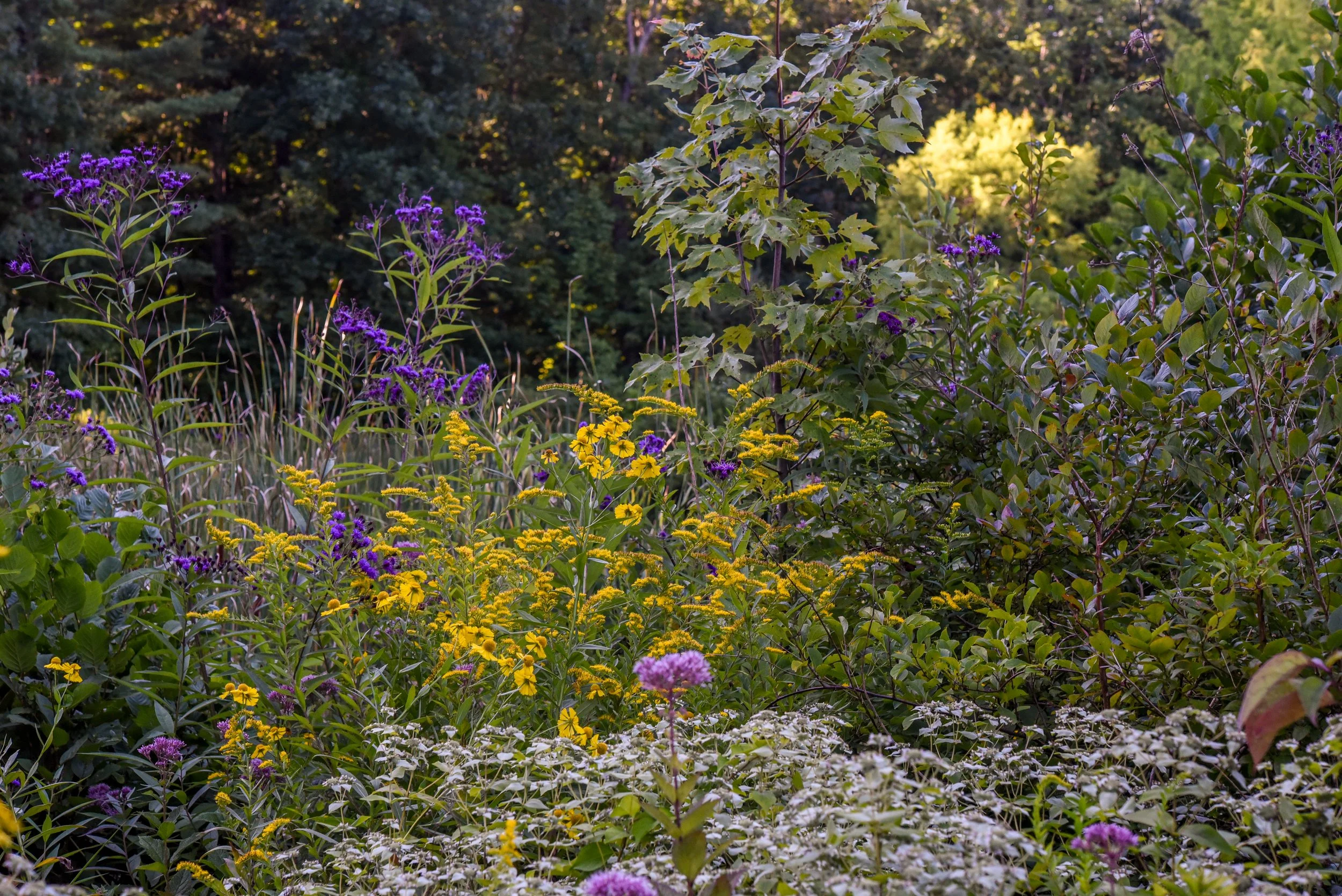
New England Botanic Garden (NEBG) at Tower Hill
Photo by NEBG at Tower Hill
In Partnership with the Place:
Site-Specific Native Design, New England-Style
An In-Person Program for Landscape Professionals
Produced by:
New England Botanic Garden at Tower Hill
New Directions in the American Landscape
When: Wednesday, September 24th, 2025 | 9:00 - 5:00 PM ET
Where: New England Botanic Garden at Tower Hill in Boylston, MA
Instructed by:
Hunter Blanchard, Steven Conaway, PhD, Robert Graham, and Larry Weaner, FAPLD
Program Description:
Uncovering the often-hidden vegetative characteristics of a site can help designers enhance botanic diversity, while curating inspirational places that elicit a true sense of place. This full day session will include classroom presentations and field exploration of both meadow and woodland landscapes. Presenters, including designer Larry Weaner and ecologist/horticulturist Steven Conaway, PhD, will show how deep site analysis can help designers recognize and incorporate a site’s inherent inclinations - be it for a restoration, a garden, or a blend of the two.
What’s Hiding in the Landscape? Uncovering a Site’s True Potential
Steve Conaway & Robert Graham (indoor lecture)
In this presentation Steve and Robert will discuss the essential work of site assessment in uncovering the plant community traits, ecological processes, and past human activities that inform New England’s widely varied landscapes. Through historic land use records, observations on the ground, and regional resources they will show how to effectively reveal the potential diversity and ecological character of a site. With insights from the past and analysis of the present, designers can more successfully enhance botanical diversity while curating inspirational spaces that elicit a true “sense of place.”
Guiding and Enhancing Vegetative Potential: Assessment into Design
Larry Weaner (indoor lecture)
How does the deep site analysis described in the previous presentation translate into an ecological restoration, a garden design, or a blend of the two? How does spontaneous recruitment of wild plants and the self proliferation of planted ones fit into a designed planting plan? Through case studies of New England projects on a variety of scales, Larry will illustrate how ecological characteristics and processes like disturbance, competition, conservatism, plant colonization, senescence, and ecological succession can combine the existing vegetative inclinations of a site with the practical and artistic visions of the designer and client.
Forest Walk (outdoor walk)
Steve Conaway and Hunter Blanchard
We will visit and compare two woodland habitats where we will discuss how their varied environmental conditions and disturbance histories have affected their current vegetative compositions. These will include an upland, Oak-dominated forest where a host of native herbs dominate the understory, with little to no invasive species presence; and an adjacent lowland forest where invasive species abound, but with occasional novel species like rattlesnake plantain and large whorled pogonia.
Field Walk (outdoor walk)
Robert Graham and Larry Weaner
We will visit multiple meadows with varying compositions and histories, including a native meadow that was planted in 2021; an older meadow dominated by pasture grasses and many of the broadleaf forbes that commonly associate with them; and a wet meadow containing a large population of native forbs and shrubs, managed by period mowing. Finally, we’ll visit an invasive plant-dominated vernal pool and discuss aggressive vs. gradual approaches to a native plant transition.
Instructor Bios:
-
Steve Conaway, PhD joined New England Botanic Garden in 2024. Steve developed an early passion for plant science and sustainability working in crop diversity preservation on farms in New England. He studied environmental horticulture at the University of New Hampshire and plant pathology at The Pennsylvania State University where his doctoral dissertation centered on the control of invasive weeds with naturally occurring fungal pathogens. As Conservation and Outreach Director at Greenwich Land Trust, he led educational programming and directed ecological restoration projects on 750 acres of protected open space. Before joining the team at NEBG, Steve worked as the Associate Director of Horticulture at Wave Hill where he focused on the health and beauty of the gardens, greenhouses, and woodlands.
-
Robert Graham is the Land Steward Supervisor at New England Botanic Garden at Tower Hill. He has been with the organization since 2017 and is responsible for overseeing all formal groundskeeping as well as management of all naturalistic areas including meadows, woodlands, and wetlands. Robert earned his BS in Biology from Worcester State University where he focused on conservation biology and GIS. His professional interests include early successional habitats, native plant ecology, and sustainable land management.
-
Mark Richardson is Director of Strategic Horticulture Partnerships for New England Botanic Garden. In this new role, Mark serves as executive director for two membership organizations with complimentary missions: Botanic Gardens Conservation International US and the Ecological Landscape Alliance. In his previous role as Director of Horticulture, New England Botanic Garden became the first botanic garden in the nation to earn Green Zone certification from the American Green Zone Alliance. Mark also served as Botanic Garden Director for Native Plant Trust, where he oversaw Garden in the Woods and Nasami Farm native plant nursery. He is co-author of Native Plants for New England Gardens (Globe Pequot, 2018).
-
Larry Weaner, FAPLD, founded Larry Weaner Landscape Associates (LWLA) in 1982 and New Directions in the American Landscape in 1990. His nationally recognized work combines horticulture, landscape design, and ecological restoration, and spans more than twenty U.S. states and the U.K. He has been profiled in national publications. His book, Garden Revolution: How Our Landscapes Can Be a Source of Environmental Change (Timber Press, 2016), co-authored with Tom Christopher, received an American Horticultural Society (AHS) Book Award in 2017. In 2021 he received the AHS “Landscape Design Award” and the Association of Professional Landscape Designers (APLD) “Award of Distinction.”

“You have made a great contribution to the field through your conferences.”
– Leslie Sauer, Andropogon Associates, Philadelphia, PA
Photo by Max Touhey
What past in-person NDAL program attendees are saying:
“Always good to be out in the field ‘seeing’ the landscape through an ecologically technical lens and hear the successes and lessons learned from practical experience.”
“That was so valuable! The specifics were awesome, like traits of individual plants & design ideas (combinations & plants that tolerate each other in space & time). Specifics on species’ seed germination were wonderful!”
“This program really spoke to me. It addressed many issues I come across and inspired me to continue my work in this way.”
“Excellent as always! ”
Registration Details:
-
When registering on the NDAL Participants Portal you will be asked to either sign into your existing account or create one. This account will give you exclusive access to the session recordings and course materials. These materials will be available until three (3) months after the live event dates.
Registration will be refunded only if notification is received before ten (10) working days prior to the live event date less a $10 processing fee.
-
To register multiple people/staff members at once, click Register, then enter the number of registrations needed under “Quantity” on the left side. You will receive an email with an invite link to send to all the registrants in your group. **Please note: 1) ALL participants must click the invite link to officially redeem their registration for the program and 2) if you are registering yourself as well, you will NOT be automatically registered under a Group Order; you will also need to click the invite link to redeem your registration.**
-
Students please choose the Student Rate to register and bring your student ID/verification of student status to the program.
-
Wild Ones members please email info@ndal.org with verification of member status (ie. Membership ID card) for discount code or look out for an email from NDAL/Wild Ones with the code.
-
Northeast Organic Farming Association (NOFA) Accredited Organic Land Care Professional (AOLCP) members please look out for the discount code from NOFA, or contact Jennifer Shaffer, NOFA Organic Land Care’s Program Director at jennifer@ctnofa.org for the code.
-
Offer your colleague, friend, or relative a chance to attend this program. Gift them registration by selecting “This is a gift” on the checkout page.
Thank you to our Institutional Ally:
Thank you to our Continuing Education Ally:
Questions? Please contact:
New Directions in the American Landscape
info@ndal.org
510-518-0430

Photo by Mark Weaner